Sunday, April 13, 2008

IR Lesson No. 8 More Holds

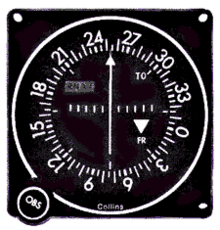
Today's lesson pretty much mirrored last Sunday's lesson. Of course after a week off I needed to knock off some rust. Today we started to refine the procedures. I did the approach briefing, set up all my comm and nav's for my flight and selected the ILS RWY 6 approach for KABE, Allentown Lehigh International.

We started the flight at 3000' and somewhere north west of the East Texas ETX VOR. Also, from this lesson forward there will be wind and turbulence to deal with, obviously the honeymoon is over. As Brian previously stated there is no smooth IMC conditions,so deal with it. Ok, the ground rules are set and I need to step up my focus. The only real problem that I find myself having to correct is altitude. Yes, this is a real problem especially when flying instruments. It took me almost twenty minutes today to get my self squared away. I was plus or minus a hundred feet consistently and when going missed I leaned over to hit the OBS button on the Garmin 530 and nosed the plane over at the same time. I needed to keep my scan going but instead focused just briefly on the GPS which called for an immediate scan quickly followed by a recovery. Yikes, any passengers would have lost their lunch.

In review my hold patterns were good despite the winds and turbulence tossed at me. I worked on adjusting my outbound leg times in order to hit the 1 minute inbound to the intersection time. I had a nice tail wind inbound so it called for extending my outbound leg by 10 to 15 seconds. My altitude control was much better and the hold patterns looked good on the computer screen that the instructor is watching. I'm up again this wednesday followed by next sunday.

Sunday, April 06, 2008

IR Lesson No. 7 Intersection Holds

I headed up to the flight school to pay for my missed lesson this morning. I figure it's the least I can do is pay for his hour since I stood my Certified flight Instructor, Instrument (CFII) up. When I got there he asked if i wanted to do an hour in the sim. Sure, why not, it will erase all the frustration I'm feeling for making the no-go decision on our flight to Florida. Flying has a way of making everything else just fade away, I was hoping the sim did as well.
Brian and I briefed the (KABE) Allentown/Lehigh Valley Airport ILS RWY 6 Approach. Reading from the top down key notes are the localizer frequency, approach course, airport elevation, lighting, missed approach requirements, necessary radio frequency's and so on. The plan was to have me take off on runway six climb to 3000 and track direct to the ETX East Texas VOR. This is the point I will begin to fly the approach. No sooner I am wheels up at ABE I am in Instrument Meteorological Conditions (IMC). I climb out to 1000 and begin a turn to the north minding altitude, climb rate and attitude. I dial in the ETX VOR and the direct to heading is 240*. This looks pretty good and should provide an easy entry at the Initial Approach Fix (IAF) JISTO intersection. As I approach ETX I slow to 90 knts and extend flaps to ten degrees so that I can keep my airspeed steady and then follow with landing checks. Mixture, tank that is most full and finally landing lights. I cross ETX and turn left to a 169 degree course, no timer set here but a twist on the heading bug. I also twist the CDI heading to the localizer heading 063* for a reference.

As I approach JISTO I need to check the plate again to confirm my outbound heading ( I need a yoke clip) . The outbound heading I am looking for is 213* for 1 minute and then I'll make a Teardrop entry for this course reversal. At one minute out I begin a standard right turn to the inbound heading of 063*. As I turn then twist the heading bug the localizer comes alive and as I arrive at the new heading I'm centering the CDI needle. Woo Hoo, I'm doing ok so far. I am now descending at 500 feet per minute holding 90 knots looking for an altitude of 2400'. I get to altitude a bit quick and level off until I cross the SHAGY intersection, the final approach fix (FAF). At this time I can descend to a decision height (DH) of 594' until the Missed Approach Point (MAP). I start my timer as I cross SHAGY and confirm it's an even four minutes flat until MAP. Holding steady at 600' I see the lights for ABE along with the runway environment. I am cleared to land! I add in another notch of flaps and enjoy the wide runway for a nice landing.

We did a quick review of my flying and we discussed my scan technique and what I needed to do to address altitude changes. Brian said it looked like the scan included the correct instruments but I conscientiously made the decision to not interpret what my altitude was showing me. I tend to verbalize what I am doing and I would call out altitude to be corrected but just move on to localizer corrections. Strange how the brain works, especially mine.

Next up we are going to work on holds at an intersection. We reviewed the plate again and I answered questions as they were brought up. Missed approach procedures, pretty simple they are blocked out at the top of the plate giving you altitude and directions to follow. Ok, climb to 3000' via heading 063* and STW R-243 to MURDE intersection/STW 20.5 DME and hold. Whew, take a breath.

Let's see if I can break this down so that I can still understand it all. If I am going missed I can continue on the runway heading 063* while climbing to 3000'. Next I need to ID the MURDE intersection. This should be fun. I had previously dialed in the back up nav 1 the STW VOR frequency of 109.6 and on nav 2 I had the SBJ VOR in the standby 112.9. Not that I knew I was doing it right but this is how much rope Brian gave me. Ok nav 2 is dialed in and the heading is 309*. When I start my climb when going missed I'll twist my heading on nav 1 to 243* from STW and tune that in to read out on the DME (looking for 20.5). I should do a parallel entry to the hold but I like the teardrop and feel more comfortable doing it. So, as I approach I will cross the intersection when I see the needle swing on nav 2 that I crossed the 309 radial and my DME should read 20.5. I'll then turn to a heading of 030* for 1 minute and follow with a right turn to intercept the 243* radial from STW. Once wings level I'll start the timer again and head inbound for a minute. I was a tad bit fast inbound and as I hit the 20.5 DME the timer ran through 1 minute 10 seconds. Not to shabby for my first go.

I continued on for another lap around the hold trying to settle in with all the turns, times and whatnot. It gets overwhelming very fast but at least it erased all the frustration from my earlier no-go decision for Florida.

1.2 hours in the book and I am scheduled for Sunday the 13th. I'll be taking the week off to explore Sun-n-Fun and take plenty of pictures. I'll get to posting when we return. Until then, fly safe!!

'No-Go' Flight Sun-N-Fun

I got up at 5:30 this morning to give the wx for our trip a last look knowing that I needed to make a decision on our flight. Every pilot is aware of the killer "get-there-itis" syndrome and to be honest I was holding out this morning searching for some miracle. News flash, there were no Angel's singing or bright lights from heaven, take this as a not so good sign.

After countless checks on the AOPA wx pages and wearing out the 24, 36 and 48 hour ceiling, visibility, surface wind charts along with DUAT and the Vans Air Force wx pages, I was faced with the fact I had to make it a no-go for our flight to KISM, Kissimmee Florida.

My Private Pilot training was kicking in and common sense took command. As bad as I wanted to fly there I didn't want to put Mary or myself in a bad situation and risk flying into even worse wx in route or a pop up thunderstorm. Mary and I both agree 'when in doubt, don't go out' and that's what I promised to us both.

I went back up to bed and let her know that we were a no go and needed to decide on what flight and airport to leave from. We could have saved $300 on our round trip if we wanted to drive 90 miles to KBWI, Baltimore in Monday morning rush hour traffic. We both decided it would be much better to get up, have breakfast make sure all is in order and have the shuttle pick us up at 11:30am for our ride to KPHL, Philadelphia. We booked round trip to Orlando and have a car scheduled for us when we arrive.

I don't feel any better for making the right decision but at least I'll still be here to sulk rather then risking a bad decision and my friends reading how stupid I was in some NTSB report. In all the rush this morning I forgot about my 7am scheduled Instrument lesson (the other reason I got up so early). Brian left a message on my cell and I called back to to leave him a message that I'll square up with him for standing him up (a first for me). We eventually caught up and he fit me in a time slot for 1.2 hours of ILS approaches and holds at an intersection. Fun stuff!

If anyone is heading to sun-n-fun on US Airways going through Philadelphia on the 1:45 flight, we'll be there in row 18, Mary sleeping and me pouting as I watch the world go by out my little window from inside the stinkin' spam can.

Thursday, April 03, 2008

IR Lesson No. 6 GPS Approach

Another 7am start for my sim time lesson. Brian and I both walked in and got right to business. He fired up the sim and I grabbed the checklist and my knee board. I was on a very tight schedule this morning due to meetings at work so I didn't want to run long. That had to be a first, me not wanting to fly, sim or in reality!

Brian started me out at 3000' over the top of Brandywine (KOQN) and vectored me direct to the Pottstown vor. I was really wanting to hold altitude to standards. I crossed the Pottstown (PTW) vor and continued with various turns to new headings that eventually turned me back inbound to Pottstown (PTW). I was going to fly the GPS RWY 9 Approach into Brandywine Airport. Together we set up the Garmin 530 for the approach with my initial approach fix (IAF)as ECZEL. I was on heading 240* and holding steady at 4000. So far, so good. This is where you would think it goes to hell in a hand basket but it didn't, the flight was actually going smooth.


As I approached ECZEL I ran my landing checklist and configured the plane for 10* flaps at 90 knts with a 500 fpm descent rate. Three miles later I was crossing the IAF and flowing through the five T's (turn,twist,time,throttle,talk). I turned course to 178*, no timing here, twisted the heading bug and CDI to 178*, adjusted throttle and there was no talk since we were not working on communications. I was really doing well, holding on course and altitude. In just five short miles I was again working through the T's crossing CEFSY and setting a new heading to 088* and now good to descend to 2100'. In another five miles I was crossing the FAF Waccy, and continuing with my stable descent to a minimum descent altitude (MDA) of 920'.

As I approached 920' I held level until crossing the missed approach point (MAP) point that was five miles from Waccy. No runway in sight I went full throttle into a climbing right turn to 2900' direct to CEFSY to hold. This hold was different, my first parallel entry and not timed but working off a given distance from the fix. I crossed the fix and continued outbound for four miles then made a standard rate left turn to a heading of 050* to intercept the inbound 088* radial. It went pretty smooth.

Time was up for me so we ended the session at that point and followed up with a brief review as we took care of payment, scheduling and signing my log book. I was rushing some today but still had a great lesson in the Elite RC-1 sim. Next lesson is this Sunday 7am.

Wednesday, April 02, 2008

Night Flight 3525U

Mike offered me some right seat safety pilot time and of course I can't pass up any flying. I gave my Bride a heads up that I would be home briefly for a quick bachelor dinner (Mac&Cheese) and a few gulps of ice tea. We literally passed by each other on our street since she worked past her normal time and I needed to head to the airport by 5:15pm.

I have to add here that I have been running around like a crazy man, or so it seems. Instrument lesson four times this week counting one this coming Sunday, little league baseball practice with opening day this Saturday and all the while trying to help Mary get ready for our Florida trip. Hey, I did manage to get some wash in and swap out dryer loads. Mary is getting the packing list completed, taking care of the dog and cats and everything else you can think of that would be on the list. That's my Bride!

Traffic wasn't to bad as I made my way to Wilmington for our flight. I even considered taking
679er up when we returned to knock out 3 night landings. Atlantic is a very nice FBO on the south side of the field . They keep the facility looking sharp and the folks who work there always seem to be in a good mood. Mike and I walked out to "two five U" as he calls her, and I got in the way of his pre-flight ritual. Kidding, I tagged along pulling the nose plugs and pitot cover then stowed my flight bag before we both walked in for a wx check.

ATC was busy getting Skybus in and out in short order. During our pre-takeoff checks ATC was also trying to get a corporate jet out in a very limited window of time while managing a cherokee doing T&G's and getting us cleared to runway three two. I watched Mike as we taxied out checking instruments as I was just instructed by my CFII. It's nice to see it happen as I had practiced (on the flight school sim). It was a perfect night to fly, okay, maybe a tad less wind would have made it perfect. We were soon climbing out on runway three two in no time as two five U gobbled up the early evening air. The visibility was great, Philly was in clear view along with the Pottstown cooling towers and at about 40 miles to the north you could see the hills around Boyertown, PA. Not to shabby!

Mike briefed the approach plate for ILS RWY 29 at Chester County (KMQS) and then transferred the control to me so he could put his foggles on. Once he was set to go the standard transfer of "my plane" and "you have the plane" took place and I was back to eyes out looking for traffic. It really was quiet at Chester County, we had the place to ourselves.

I knew this approach, I flew it in my IR lessons. It was nice to now watch it unfold and listen to Mike call out position. After adding an outside look to his scan and identifying the airport Mike handed over his designer specs (foggles) and configured 25U for landing. He added another notch of flaps verbalized the GUMPS mnemonic again then shortly settled in over the numbers and with stall horn breaking the silence he set 25U down very nice. Of course as a typical pilot he thought it could be better, we are always so hard on ourselves. We taxied back then checked out the plate for the VOR A into Brandywine (KOQN).

Mike entered the info into the GPS for the next short hop and approach. As Mike refers to it "plug and Chug", I cracked up. A quick call on the radio and a visual for traffic in the pattern has us departing two nine and overflying the now dinner time community. Fond memories of Coatesville and Sadsburyville rush through my mind as I survey the new homes and Route 30 off our right wing below. I remember when this was all horse country, how times have changed.

As we depart the pattern Mike hands 25U over to me for some right seat time which feels really strange. I track us direct to the Modena (MXE) VOR which is the Initial Approach Fix (IAF). I am holding altitude at 2000' until I cross then Turn to 052* and begin descent to the MAP 1120'. At this point I turn over control to Mike since he is "twisting" (setting the heading bug and CDI) and re-setting the timer followed by the "Talk" portion notifying OQN of our position. We circle to land on runway two seven with another good landing in the book.

Unfortunately we are headed home to Wilmington (ILG). On a night like tonight you could easily fly for hours but we must get back to reality. I think I must have said it a few times tonight that for those folks who don't fly they have no idea what beauty they are missing.

We make our way towards ILG checking out Mike's neighborhood as he ID's many of the areas passing below us. I struggled to spot ILG and Mike had it in no time. I need to work on the night vision thing! I share some of the radio work and contact ILG tower to alert them of our position and intentions. We take runway three two left downwind entry. There is a jet on final for runway one and the tower asks if we could switch run way one four. Mike and I look at each other and he would rather three two so I inform the tower we would rather three two and ATC gives it up and requests us to maintain at or above 1500 for traffic on final for r/w one. I acknowledge "left downwind three two, maintain at or above 1500' and we have the traffic". Things work out just fine and we watch the jet pass below us with more then 1200 feet between us. Cleared to land as our captain pulls the power and makes for a turn to base followed by a short final. Nice and smooth as we cross Rt. 13 followed by another very good landing. The tower asks us to stay with him as we taxi to Atlantic Aviation. The video was taken with a handheld Sony Cyber-shot 5 mega pixels camera that acted up all night until I gave it a good smack.

A great flight and a lot of fun! As every great flight should end we had a quick bite to eat at Arners Restaurant and pretty much closed the place. Always great hangar flying with Mike and a nice night of flying. We hope to catch up when I return from sun and fun. I hope I'll be needing a safety pilot real soon!

Tuesday, April 01, 2008

IR Lesson No. 5 ILS/GPS Approaches

This was my first weekday lesson and it called for getting up early and out the door for a 7am start. I sat up watching King videos for the ILS and GPS approaches and before I realized what time it was our grandfather clock was chiming 11:15pm. I pulled the plug on the computer and got up to bed hoping to get some decent sleep.

5:30 am and the eyes spring open, ready to get moving. I lay in bed thinking I may catch a few more winks but it’s hopeless. Maggie is up and moving from one side of the bed to the other trying her best to indeed convince us that now is the time to get up and get her breakfast. One must be very careful not to let a foot slip out from under the covers otherwise it will be quickly licked in hopes of speeding up the “get out of bed” process.

I shower, dress and make an effort to down a few gulps of orange juice as I get ready to walk the Maggie girl and toss my flight bag in the truck. Its overcast here this morning with a light rain making its presence know with off and on again drops on the windshield. I arrive on time at the flight school and Brian soon follows. By 7:05 we are reviewing the plates for
ILS RWY 29 at Chester County (KMQS) and giving a brief look at the GPS RWY 9 at Brandywine (KOQN).

METAR KMQS 011100Z AUTO 18007G17KT 360V010 2 1/2SM RA OVC006 13/13 A3004

METAR KMQS 011120Z AUTO 18009G21KT 010V010 5SM BR OVC005 13/13 A3004 RMK AO2

As I complete my pre-taxi and run up I notice the ceiling closing in. The Elite RC-1 Sim has me sitting on runway two seven ready to depart as Brian brings down the cloud level and is so happy, in an evil sort of way, to introduce me to sim wind. Winds are set from the south at 8 -10 knots with gusts of 17-21. I quickly notice the wind on takeoff and as if this sim wasn’t sensitive enough I really have my hands full holding course and maintaining my climb. As usual I am directed to a heading of 000* and altitude of 2500’. Once at altitude I am given vectors to the ILS 29 approach at Chester County. Somehow the localizer comes alive, God only knows how I got here but I’m turning inbound and below glide slope (GS). Ok, Turn, time, twist. Throttle and talk; I’m turning inbound but not timing until the Outer Marker ‘Moses’, I twist heading bug on my DG to course 293*, check throttle setting to maintain 90 knots with first notch of flaps and no talk today since we are not doing radio work.

I normally would call out left or right of course and my location relative to the GS but I was having a heck of time just trying to maintain my wind correction on the ILS and keeping my scan going. It’s looking pretty ugly I think but I am still tracking inbound. I'm finally starting to settle the localizer needle and correcting my altitude to not drop below 2400’. I started the timer as I passed the OM and completed my landing checks without grabbing my checklist (I didn’t want to read/distract myself). Mixture full rich, landing light, fuel pump on, switched to the full tank. My rate of descent is looking good around 500 fpm as I call out altitude and looking for MAP altitude of 910’. My hand is now getting antsy on the throttle as I call out 1000’, 950, 940,920 and 910 going mis…….runway in sight!

I add a second notch of flaps, take a deep breath and reduce power to set up for my landing. No time to relax, I need to land in this cross wind. It’s not a pretty landing but the sim aircraft will fly again as I raise flaps and start to slow for a right hand exit to the taxiway. We review the approach, what was good, what needs attention and he adds that I did good considering the wind, gusts and turbulence he tossed in. I must have rolled my eyes because Brian commented that in IFR there is no “smooth” ride, the more you can handle here in the sim the better off you will be.

I get re-set for somewhere between OQN and MQS and shoot the approach again this time holding course much better and making gentle small corrections to compensate for the wind. I did get a little wacky as I broke out at 950’ this time rocking the wings pretty good and betting that my pax would have required the use of the sic sac in the seat pockets.

Brian re-sets again and I am off to try my hand at the GPS 9 Approach into Brandywine (OQN). I set up the Garmin 530 for my approach. I am directed to the ECZEL Initial Approach Fix (IAF). At ECZEL I turn to a course of 178* maintaining 2900’ to the CEFSY fix. No timing here on the GPS approach so I twist the DG heading bug and the CDI to reflect the new course. Throttle is set for 90 knts and I add the first notch of flaps to help me keep stable. No talk required today but this too will eventually add to my work load.


The Garmin 530 gives the new course setting as you get to the fix and I turn left to 88* again flowing through the 5 T’s. I start my descent at 500 fpm and pass through the WACCY FAF just under 2100. Minimum descent altitude (MDA) is 920’ so I call out on course and altitude looking for 920. I am ready for missed if needed and that would be a climbing right turn to 2900 direct to CEFSY and hold. Ok, back to focus on my scan and review my landing checks, mixture full rich, landing light, fuel pump on, switched to the full tank and descent looking good. Altitude 1000, 900, 950, 920…set to go missed and I have the field in sight. I add a second notch of flaps, pull some power and make a good landing.

A very busy lesson today with the need to pick up the pace on my scan and not fixate on the heading. This IR stuff reminds me of the old Ed Sullivan show (showing my age now) when he would have the people that spin/balance multiple plates on the poles. Well, that’s how it feels with the scan when the work load gets busy. It's like running from one plate the Attitude Indicator, making it just in time to reach the far end and put a spin on the Altitude and finally making it just in time to catch the Airspeed as it wobbles out of control. I'm exhausted just thinking abut it! Even though the instruments are grouped in a tight group I feel like I am running back and forth across the stage catching things when they are on the brink of dropping to the floor. Brian tells me I am doing good, handling the workload and that it WILL increase. He reminds me to be patient and keep up with my practice. The pace I am on will allow me to slowly add to the workload. When we get to flying the actual workload will seem a lot less then what I am doing in the sim. I guess it’s like my PPL lesson, baby steps.

Sunday, March 30, 2008

IR Lesson No. 4 ILS Approach

Another early start to a beautiful day. It is sunshine blue sky today and the air is crisp with a clean fresh smell. Other then not having 679er available it would have been a GREAT day to fly. 679er is headed home from the shop with a fresh oil change and one new mag rotor that had to be replaced. I'll try to get some left seat time prior to our departure for vacation on Monday.

I made a quick stop for cash today at the local Wawa, no additional fee when you use their ATM. I met a nice lady, who I held the door for, that asked if I was from Wisconsin. I was wearing my Packers fleece pull over today with a pair of shorts. I politely said no but informed her that I was a Packer backer since I was wee high (hand motion to a toddler's height). She then asked if I had been to the stadium. I happily said yes, that I have been on the tour, shopped the pro shop and was in the audience for a Mike Holmgrem (ex-coach) TV show. I also let her know I have a friend in Appleton that took me to see all the local attractions, heck I even had a Brat(rhymes with lot). I jumped in the SUV and headed to the school, it had to be a good lesson day, the karma was feeling great!

Brian arrived just after I parked out front. We immediately got to the business at hand with a preview of today's lesson. Today we were going to start adding to the list of things to do. I was given instruction for a departure runway two seven and turn north to 360* maintaining 2500'. I quickly noticed Brian shorted my fuel load after I had completed my pre-taxi and run up checks. On climb out he said this bird really wants to climb today and I said it should on half the fuel load. He gave a muffled laugh and said very good.

As Bo Boggs often says (Flights of the Mouse), "she was climbing like a homesick Angel." I climbed out to 2500 and once passing through 500 I turned north to the 360* heading. Brian kept things pretty simple with no added workload of the radio. The ILS RWY 29 Approach plate notes RADAR REQUIRED, this means you will be receiving vectors to final in order to intercept the ILS. We had reviewed the plate prior to takeoff discussing important facts for the lesson. This however was not a "briefing" of the plate since we will get into that as the lessons progress. I did note the important facts, the frequency is 108.5, the missed approach (MAP) is 910'/ 3/4, and going missed calls for a climbing left turn to 2400 direct to the modena (MXE) vor. I also noted the final approach fix (FAF) to MAP at 90 knots is timed at 3:20.

I intercept the ILS and announce localizer is alive and with gentle corrections track towards the Moses Outter Marker (OM). I verbally call left or right of course and announce glide slope is alive when I get some movement. The Outter Marker beacon sounds and I set my timer to zero and hit it again to start my clock. On course, below glide slope to intercept, speed 90, now adding first notch of flaps. Stable, 90 knots, 500 feet per minute descent, on course, on glide slope, things are looking good. Altitude is now falling through 1100' as I call out looking for 910', on course on glide, speed 90, 500 fpm descent. At just above 950 I break out and locate the runway, right of center. I add the second notch of flaps and make an ok landing a tad fast.

Brian resets and I do two more approaches with the last getting screwed up. I was lined up looking good as my altitude came through 1950 I brain farted and thought it was 950 and announced going missed. No sooner I added power I caught my mistake and continued on with the published missed.

Brian paused the sim so we could discuss options. Ok, you are going missed, which you can at any time if the need is there but now when and where do you start the climbing left turn and why? My eyes must have been rolling around in my head like a cheap amusement park prize for knocking over the milk bottles. Ok, focus and answer the questions step by step. I am located between the OM and the MAP at 1950' full power and climbing out. I can NOT turn left until the MAP which I will determine when I hit 3:20 on my timer (Thank God I started my timer) at that point I will turn left to approximately 110* direct to MXE vor that I set up prior to my approach in nav 2 standby. Ok, time in, get back in there and fly the missed. I am tracking 110* TO the vor and will fly the published hold. A quick look at the plate reveals a teardrop entry on my current heading. The outbound radial is 149* so I contiune to track 110*. As I cross the station I hit my timer to fly outbound for 1 minute. At one minute I make a standard rate right turn to intercept the 329* radial. The session ends.

We sit and talk about the lesson, the need to time the ILS and how to use my equipment as a way to double check. Brian suggested setting up nav 2 so that I would have localizer if nav 1 failed plus it provides a back up. I was correct in having nav 2 dialed in for my missed which made the work load a bit easier by just needing me to hit the flip button to start tracking. Next lesson we will work on procedures on a more in depth level, talking about when to brief and how to make use of your time flying single pilot IFR.

Next up Tuesday morning 7am!

Thursday, March 27, 2008

Sun-n-Fun Flight Plan Leg 1

I previously ordered sectionals for Washington, Charlotte, Jacksonville and Miami along with an Airport Facility Directory (AFD) for the South East. I inked in my flight path on all the sectionals, printed out updated airport knee board sheets for the planned stops and alternates along the way for fuel, eats and possible overnight accommodations. I also updated my Flight Guide publication.

Leg 1 of the plan will depart from Wilmington and head south west towards Easton, MD (KESN) at a planned altitude of 6,500'. This may change depending on the winds aloft but I had to start somewhere. 6,500 takes me over the Restricted area at Patuxent River Naval Air Station, Class Delta. From this point I will turn to a more southern route to intercept the Colin intersection then on to the Hopewell (HPW) VOR just south east of Richmond Virginia. From the Richmond area I will keep it pointed to the south, crossing into North Carolina and tracking to the Kinston (ISO) VOR.

The Kinston VOR is located east of the Seymour Johnson AFB. If I am crossing my checkpoints as planned we should be 2.5 hours into leg 1 with just an hour left until arriving at KCRE, Grand Strand in North Myrtle Beach. A slight jog towards the south west and 110 miles to go for the first stop. I'm sure Mary and I will be looking forward to a good lunch stop and nature call not to mention the need to top off the tanks in 679er.

The Leg 1 plan by the numbers - 388 miles, 3 hours 26 minutes flight time, 34 gallons of fuel. (I flight plan for 10 gallons an hour even though 679er burns 6-7 gph). 679er will be home tomorrow with a fresh oil change, plug check and the landing light and nav light fixed.
Sun-n-Fun Flight Plan Leg 2

Upon reaching our fill of food, fuel and wx updates we will saddle up and get leg 2 of our trek to sun-n-fun underway. One of the nice things about Grand Strand is that you can pick up a squawk code for flight following prior to take off. I will also open our flight plan plan prior to launch. Our plan of attack will have us departing KCRE on a course south west at 240* passing directly over KMYR, Myrtle Beach Class C above 4000' and climbing to 8500'. Our course will keep us clear of the Gamecock B Military Operations Area (MOA)and keep us pointed towards KCHS, Charleston AFB/International Airport. Once southwest of Charleston we will pass above the 7000' ceiling of the Beaufort Two MOA and set our sights on the Savannah VOR. We will be passing west of the city so I'll have the better view but will try to get some pictures. After crossing the SAV VOR we will turn southward to 197* and travel along the Georgia coast passing below the 11000' floor of the Quick Thrust M MOA. The Brunswick VOR (SSI) is our next check point which is just southwest of 09J, Jekyll Island. Mary and I may make a stop at Jekyll Island for lunch on our return trip home.

From the Brunswick, GA - SSI VOR we will continue south to our next checkpoint the Craig (CRG) VOR in Jacksonville, FL. We will be passing just east of the Jacksonville Class C airspace as we continue south to the Orlando (ORL) VOR and hopefully cleared through the Bravo airspace to KISM, Kissimmee Airport. I have been told we will get routed over Disney so I am looking forward to some great pictures.

The leg 2 plan by the numbers - 394 miles, 3 hours and 30 minutes flight time and a fuel burn of 35 gallons. Again I flight plan for 10 gph but 679er burns 6-7 gph. In total we will have about a 7 hour trip not counting our time on the ground in Myrtle Beach and around 780 miles. It should be fun, if mother nature cooperates.

I have 4 Instrument lessons in the next week prior to us leaving so that should sharpen the skills. When we return I am going to knock out the remaining sim time and roll right into the flight portion of the rating. I hope to have my rating by the end of summer.

I am looking forward to meeting some folks at S-N-F!! Are there any readers attending???

Tuesday, March 25, 2008

Happy Easter!

I hope all our readers enjoyed a beautiful Easter Sunday. Mary and I worked our tails off and had the house looking great. The menu was planned with the family all bringing a dish to add to the holiday celebration. Mary started early, the smell of Ham cooking drifted through out the house, and it was fantastic. I had ordered the floral centerpiece for the table during the week as a surprise for Mary. My Bride loves a nicely set table and always does a fine job.

We were twelve in all as we were seated for dinner. Mary's Mom and Dad, her brother and his wife and two daughters, my sister and her husband, my brother and his wife. We had Ham, scalloped potatoes, asparagus, scalloped pineapple (made with bread topping), cheesecake, cream-puffs and I'm sure I missed a few others.

In keeping with my aviation blog I will add that Sunday was a gorgeous day to be flying. Every time I looked outside or let Maggie out back to run I had wished that I had some time to get in the air. As much as I wanted to fly today the time spent with family is so much more rewarding.

Happy Easter!

Saturday, March 22, 2008

IR Lesson No. 3 Holds

It was an early start this morning, taking care of the Maggie girl (our Italian Mastif)and heading to the flight school for my lesson. I wanted to practice last night but instead spent quality time with family. Mary and I met up with my brother and his wife to have dinner at a local restaurant, "Lotsa Pasta". The eats were good, service fast and the company was entertaining as always. Needless to say my best laid plans for some hold practice time on the home flight sim went out the window, oh well.

Brian opened up shop promptly at 7am and I followed in like a lost puppy looking for breakfast.....um no that would be knowledge. The Elite RC-01 sim came online as we went over today's lesson. This morning was my introduction to holds. I have went through the King DVD's, read multiple pages on the internet and followed many threads on the forum. I at least felt that I was informed.

The approach plate for today was the VOR-A at KOQN, Brandywine. Prior to start up my instructions were to climb and maintain 2000, on a heading of 000* until directed to proceed direct to the Modena VOR and hold. With my start and run up checks completed I was climbing out to 1200' in IMC then turning on course as directed. The sim is set to be very very, did I say VERY sensitive.
As Brian stated, "if I can fly the sim to Practical Test Standards (PTS) I will be fine in the aircraft." I am instructed to proceed direct to the Modena MXE VOR and hold. I dial up the MXE VOR on the Garmin 530 and off I go. I'm about 13.5 miles north and dialed in to course 190* direct to. I review the approach plate and note it's a standard right turn hold, at this point my CFI freezes the sim and we review my entry. I begin to explain my thought process and he listens. My method would be add 70* to my heading denoting the line which provides my boundry for direct entry area, pictured above left as area 'D'. 'P' is for the parallel and 'T' is for teardrop entry areas. As you can see the outbound radial is 234* represented by the red line and it falls in the 'T' area. No brainer it's a teardrop entry. Right?
Brian nods then asks, "why would I want to work so hard? You have the plate in your hands. All the plates are configured north up so use your thumb to simulate the direction you are approaching from." Ok, I am on a south heading so I am approaching from the north and will cross the VOR with the best entry being a teardrop. I note my direction of travel/entry by the red line on the approach plate on the right.
The teardrop entry seems pretty easy with the outbound radial of 234* I enter at 204 say 200*. I start the timer as I pass the VOR holding 200* and at one minute I start a standard rate turn to the right to the inbound course of 54 say 55*. I clear and reset the timer and I am inbound for 1 minute which almost falls dead on as I right turn back out on the 234* radial. Holding airspeed at 90 kts and altitude along with heading and timing was a bit busy at first but after once or twice around the hold I settled in.

The one hour lesson was over in no time. When I turned around to look at my holding pattern the turns looked great but the pattern grew as my speed increased for a few of the laps. You could very easily see where my airspeed was right on as the size of the hold was very good and on track. Overall a good lesson and again we talked about small and gentle corrections. Brian said I was really starting to get smooth on the last few laps as my altitude finally settled in and I held my airspeed solid.

I'm scheduled the next two Sunday's and maybe two mornings a week if my work schedule permits. I'm off to breakfast with my Bride, then baseball practice at 1:30. Happy Easter!!

Friday, March 21, 2008

IR Lesson No. 2 Partial,Times,Turns

After my first lesson I decided to devote some flight sim time here at home to my recent lessons. Of course I worked on BAI, slow flight, stalls and spin recovery. The extra sim time helped, I felt I had it under control.
Lesson two I decided to use my checklists and knee board to feel more at home. The Elite RC-1 sim was working to full potential today since the 55" flat screen was now showing me sitting on runway two seven almost ready to go. I did my pre-flight start checks and then a run up before departing the sim world at KOQN. Brian had the wx dialed in and it was looking ugly. I think we entered into Instrument Meteorological Conditions (IMC) at 600 - 800'. I was given a heading to the north then directed to proceed direct to the Pottstown (PTW) VOR. Brian walked me through the Garmin 530 and I dialed in PTW on the CDI.

After crossing PTW I was given a series of turns left and right as we reviewed about scan and workload. I was holding good altitude and heading at this point. I had left my fuel pump on so I made that correction and it was acknowledged. I was cruising along at 2,500 when we started work on steep bank turns. I initially held to about a thirty degree bank and Brian asked if I intended on giving him a steep bank turn. Ok, banking right 45* altitude holding nice, looking good and rolling out on the initial heading. We flip back and forth left and right with an additional 360* turn or two thrown in. I didn't do to bad rolling out on heading and holding altitude.

Next we worked on timed turns, and I was asked what a standard rate turn was and why it is marked two minutes. A standard rate turn for (light) airplanes is defined as a 3° per second turn, which completes a 360* turn in 2 minutes or 180* in 1 minute. I did a boat load of timed turns until I had no idea where I was. I checked out the DME and noted how far I was from PTW so I was trying to paint a picture drawing a mental circle. While keeping my scan going the airspeed fell to zero but all other instruments checked out. I immediately turned on the Pitot heat and the airspeed came alive. I got a good catch, so how are we looking. I called out on heading, level and looking good....er...um....oil temp not looking so good but oil pressure good. Ok now what, said Mr CFI at the control panel behind me. I could lower the nose to help cool, Brian chimed in or run rich to cool yes? I am at full rich for the maneuvers, so I double check and I was not full rich. Ok, increase to full rich, oil temp starts to fall. Keeping my scan going or at least trying to I notice that I have a vacuum problem and the Attitude Indicator (AI) has failed. It's partial panel time.

With the failures presented, I start to re-focus on turn indicator for level flight backing it up with my Altimeter. I keep the aircraft in control straight and level on course and.....whoa! the directional gyro is spinning like an amusement ride gone wild. Again scanning/checking wings level, altitude good to go, now using my compass as my bank indicator I try and get my act together. Scan shows my altitude is starting to drop and my airspeed is increasing, I need to focus and level out to under control. Brian overloaded my VFR thinking brain. I could not believe how hard it was to NOT look at the failed instruments or even glance and still want to process their information. I notice a nervous twitch as my left leg starts to flex almost as if tapping my foot on the ground, I can't control it. Great, I keep thinking some circuits are not connecting......as I regain control of the thought process and keep my scan along with interpretation going. With the partial panel I make various heading changes, timing each turn and rolling out on the new headings. I think I'm starting to get the hang of this!

Thankfully, there was no radio work this lesson, it freed up a few extra brain cells that I needed for aircraft control. Ok, the priority is to get on the ground with my partial panel issue. I now increase the scan time for the Garmin 530. My nearest airport is KOQN, Brandywine. I set up for a stabilized descent at 500 fpm to pattern altitude. Nice and smooth with a controlled descent at 500 fpm has me breaking out at 2100' and finally seeing mother earth again. I turn across midfield and enter the upwind for two seven without timing my turn, Brian takes note. Ok, turn to crosswind will be left 90* or 30 seconds, click to start timer and follow up on heading 180*, again a 90* turn left to 090* and 30 seconds has me on down wind. Slowing to add flaps and keep my descent smooth, I make a trim adjustment. A left turn to base and I can see the runway. Second notch of flaps, power adjustment and looking good. I have the runway made so I add the last notch of flaps and set my sim flying machine down, home safely.

1.8 hours in the log with a quick review has Brian stressing the importance of keeping the scan, small gentle adjustments and working the plan, staying ahead of the aircraft. Tomorrow will be more of the same with the addition of holds. Off to study and practice!

Saturday, March 15, 2008

IR Lesson No. 1 BAI

Lesson one consisted of Basic Attitude Instrument Flying (BAI) , instrument scan and interpretation and of course aircraft control. The Elite RC-1 sim must play the role of many aircraft so it was a bit different then the Piper Archer II that I fly. I will say this, it sure was easy to climb in and out of!

Attitude instrument flying consisted of learning the aircraft performance with power, pitch and bank attitude. The sim does not provide you with the opportunity for your body to react to "feeling" or "sensation", this will come when we actually fly. An instrument pilot must learn to control the aircraft with the basic attitude flying skills.

We started out with the view screen shut off flying along somewhere in sim land between KOQN Brandywine Airport and KMQS Chester County Airport. I was level at 3000' on a heading of 270* as Brian (Flight Instructor) gave me various headings to turn to. At first I made my turns and changed course without following what I would do in the "real world" flying 679er. So, before Brian had the chance to grill me I started to treat this as the real deal, as if in 679er. My radio skills kicked in and I twisted the heading bug for every new course change, all the while keeping the scan going.

We moved on to slow flight and I went through the process to configure the aircraft. I again went through turns to the left and right setting the heading bug and confirming each course change while working on my scan. We then established that the stall for the sim was around 60 to 63 kts and that once the stall horn provided warning you were nosing over instantly. I thought it wouldn't break as much if flying coordinated (ball centered) but the sim was gone in an instant. Let's just say that I am happy I was in the sim and not flying in the soup. The Private pilot lessons kick in with the immediate stall then spin recovery sequence....reduce throttle, center ailerons, apply full rudder opposite direction of spin, yoke forward and as the rotation stops neutralize rudder and recover from dive. Just that easy...yeah right. I followed the sequence as it was ingrained in my head and it came as easy as taking a breath, the only problem is that I had no reference to the world around me. Only instruments and it wasn't pretty. I left a smoking hole somewhere in sim land near Marsh Creek state park. Not a good feeling.

Brian said relax it's something different and you will grasp it. Ok, fire me back up and let's give it another go. Round two was a lot like the first go and I left another divot in sim world. We did review what my steps were and where I lost control and what I needed to do to fix it. I was "over controling" is what it boiled down to. Round three I finally left the Attitude Indicator/Artificial Horzon AI out of my scan once it tumbled and worked with the turn coordinator airspeed and altimeter. I did better this time and only ended up flying along upside down, but straight and level. I quickly fixed that problem with an aileron roll and continued, this did not make my CFI laugh. Round four I finally got a handle on which way was up and gave up on the fixation with the turn coordinator, this was a good recovery and no passengers would have lost their lunch. Thank God! I will be practicing with the sim at home and I will start looking for some spin training.

Last on the list was adding some VOR tracking into my scan. Brian asked for me to take us home as he brought the Garmin 530 online. I dialed in the Modena VOR (MXE), gave a twist on the Directional Gyro (DG) heading bug and the Course Deviation Indicator (CDI) and away I went. We worked on some climbs along the way and terminated the session once crossing the MXE VOR.

1.2 hours in the book! Lesson one review drives home the fact that proper scan is vital to the instrument pilot and interpretation even more so. I added 1.2 hours in the log book and had a bunch of fun. I can tell, this will be a lot of work but the rewards will be justified. I'm on the schedule for Friday and Saturday.
 

Wednesday, March 12, 2008

Good News, Bad News & The IR

Today brings good news and bad news. The good news is really a double dose, I sold my 81 Corvette and I'll now start my Instrument Rating (IR). The bad news is I really hate to part with the car even though I must honestly say I don't drive it enough. Over the last two years I only brought it out of the garage a handful of times. The car deserves more attention and exercise. With our weekends now occupied with flying I just haven't had the urge to drive the Vette.

I was once told by a corvette collector that we as "owners" are really no more then care-takers. I invested money to have work done in order to maintain my Vette and now I will hand it off to another care-taker to do the same thing. The man I sold my 81 to is a collector, not just of cars but motorcycles. Frank pays attention to the details and will give my gal a good home. Heck she's going to a heated garage it has to be good! I knocked a good bit off my asking price because of where the car was going and how Frank would take care of it. I know, it's only a car but if you know someone who really enjoys cars they will tell you the same thing, it matters.

I will be going to visit the folks at TAS, Inc at KOQN, Brandywine Airport to check out the new hi-tech Elite RC-1 sim they are setting up. I will sign up for lessons Saturday and start posting my daily/weekly progress. Cloud busters here I come!

Saturday, March 08, 2008

Secure All Hatches!

ID: KILG Wilmington Airp, DE AMENDMENT
REPORT TIME: 8 22:14


VALID TIME: 8 MAR AT 22Z TO 18Z NEXT DAY
INITIAL WX


WINDS: 220 AT 14 GUST 24
VISIBILITY: >6.0 MILES
CLOUDS: 10 FEW CLOUDS: 20 SCT CLOUDS: 50 OVC
TEMPORARY WX FROM 22Z TO 24Z
WINDS: 270 AT 25 GUST 50
VISIBILITY: 2.0 MILES
WEATHER: SHRA_BR
CLOUDS: 10 BKN
CLOUDS: 25 OVC WITH CB

NEW WX STARTING: 00:00Z
WINDS: 250 AT 25 GUST 50
VISIBILITY: >6.0 MILES
CLOUDS: 15 SCT
CLOUDS: 35 BKN

NEW WX STARTING: 03:00Z
WINDS: 260 AT 20 GUST 35
VISIBILITY: >6.0 MILES
CLOUDS: 50 SCT

NEW WX STARTING: 12:00Z
WINDS: 280 AT 18 GUST 28
VISIBILITY: >6.0 MILES
CLOUDS: CLEAR

KILG 082228Z 082218 22018G40KT P6SM FEW010 SCT020 OVC050
TEMPO 2224 27025G50KT 2SM +TSRAGR BR BKN010 OVC025CB
FM0000 25025G45KT P6SM SCT015 BKN035
FM0300 26020G35KT P6SM SCT050
FM1200 28018G28KT P6SM SKC=


The wind and rain seemed to pass so I went outside to clean up some of the tree branches. I washed off the sidewalk since our mulch poured over the flower beds. The sky turned dark again so I finished up and came inside, figured I was done for the day. I was right, Mary said the wind had picked up and it started to hail. Pea sized hail bombarded the area and I have a picture that I will upload. The hot tub cover was thinking about leaving town but I went out and clipped the four corners in order to secure the top. I can't remember the last time I had to fasten the cover down.

I hope 679er is safe at the airport. I'll venture out early in the morning to check.

Thursday, March 06, 2008

KILG - Skybus Takes Off!

Wilmington's Airport (KILG) will once again host commercial air service. Skybus based in Ohio will attempt to make a go of scheduled service from Wilmington to KGSO -Piedmont Triad Airport in Greensboro, NC and KCMH - Columbus Regional in Columbus, OH.

USA Today - Business Traveler by: David Grossman

...Skybus sets sail from Columbus, Ohio, ushering in a new breed of discount airlines. With a minimum of 10 seats on each flight selling for $10, Columbus will be permanently on sale. Skybus combines some familiar features from Southwest and Ryanair, with some unique twists of its own. The carrier will offer simple pricing with one-way fares based on the actual number of seats sold and anticipated demand. "Our fares are completely inventory managed," says CEO Bill Diffenderffer. There are no advance-purchase, round-trip, or overnight stay requirements. However, there is a catch: A policy Diffenderffer refers to as "cafeteria" pricing. Skybus charges $5 for each checked piece of luggage.

Like Southwest, flights are open seating, but you can pay $10 for the privilege of boarding the plane first. Food and beverages may be purchased on board, including soda and snacks. Outside food is forbidden – seriously! And nothing is free: You can purchase a blanket and pillow (and carry them home after the flight if you so desire). The airline also offers flight status messages via email, cellphone, or pager for an additional charge. By the time you add taxes and all those extras, your $10 ticket might cost $80, but Diffenderffer boasts that price is still less than another airline's $180 fare.

Tuesday, March 04, 2008

The Legend Retires

I know this is not aviation related but now and then I stray from the world of flight to post on other passions that I have. I have been a Green Bay Packer fan longer then a fan of airplanes. I grew up in the days of Bart Starr, Paul Hornung, Jim Taylor Ray Nitschke and Jerry Kramer. When kids play football at an early age I was always Starr tossing the key pass, ok at least in my own mind. At an early age one Christmas I opened up a box that held a football helmet, pads and a uniform. I immediately set out to paint it in Green Bay Packer colors. My folks were not happy but they lived with it.

Two of my most cherished autographs are a Superbowl 1 commemorative football signed by Len Dawson and Bart Starr and an autographed picture of Bart in action personalized for me. As much as I have been a Packer fan I have been a Vince Lombardi fan. I sure would have enjoyed seeing Favre play under Lombardi.
I wish the Packers could have taken the top prize this season, a Superbowl victory, but it was not to be. Brett Favre walks away from the game as one of the greatest QB's of all time. I will miss his passion for the game, his boyish approach and his toughness. Thanks Brett for 17 seasons of Packer football!

A quote from Vine Lombardi that fits Brett Favre's style of play and his heart. "Every time a football player goes to play his trade he's got to play from the ground up - from the soles of his feet right up to his head. Every inch of him has to play. Some guys play with their heads. That's O.K. You've got to be smart to be number one in any business. But more importantly, you've got to play with your heart, with every fiber of your body. If you're lucky enough to find a guy with a lot of head and a lot of heart, he's never going to come off the field second." (Vince Lombardi)